- Admin
- Nov 20, 2020
- 3 min read

Updated: Feb 22, 2022
This weeks lecture and learning lab engaged with embodied mathematics, ethno-mathematics, pattern symbolism, the physiological effects patterning has on the body through dazzle, synaesthesia and figure-ground reversal.
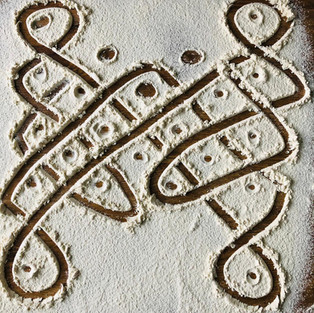
We were set some interesting tasks ahead of the learning lab. To start, I began experimenting with the Angolan sand drawings. My very basic understanding of them is that they function as a storytelling device where the teller inscribes a pattern into the sand whilst relaying a tale. My first attempt with the simplest of the drawings on the youtube video, shared with us by Dr Stephanie Bunn, went smoothly but there was a notable difference in the pace in which I moved through the drawing compared to the person in the video. Although I wasn't telling a story whilst I drew I did wonder whether elements of the story correlated to the points in the picture, this wasn't made clear. However if this was the case then my slow beginners pace would have probably impeded the telling of the tale.
I had my partner take a video from above, watching it back it seemed much clearer from a bird's eye view where I was supposed to be travelling to through the drawing. As you can probably tell from my staggered movements, whilst drawing with my finger it seemed less clear where I should be going as my concentration was focussed on the end of my finger and not so much on the picture as a whole. Hence the stopping and starting to survey where I am and where I am heading on the grid.
This switching of perceptions between travelling through the picture in three dimensions with the tip of my finger and then observing the image as a whole from above really resonated with my understanding of Tim Ingold's theories of journeying and threading through a landscape. It was when I took up the next task of making the knots this really become clear! Instantly, as I started to tie the knot with a piece of cord, I realised there was a correlation between the two tasks. The end of the cord as I weaved it through to create the loops, acted very much like the end of my finger tracing the curves and loops through the flour. Making the sand (flour) drawing look very much like a schematic of a loosened knot! Tying the knots further drew my attention to the link between drawing and traversing landscapes by walking, as the knots where created by a single continuous line/thread, but the twisting and looping created a topology, a 3D landscape with an inner and outer world. Similar to Ingold's theories of path making and wayfaring.
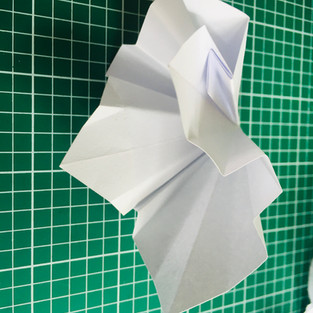
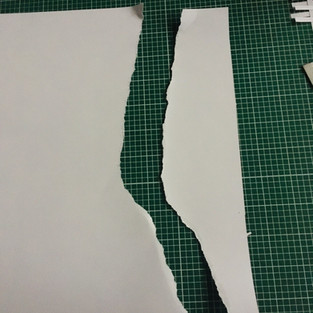
The third aspect of the task asked us to take one material and make a further ten from it. I chose paper simply because for me it was the least determined of the materials that were suggested (clay, grass etc) and in that way had the most potential for variety. I started out with one sheet of paper. My first inclination was to fold it and make origami structures. As the task asked us to make new materials I didn't continuing this. Although in one of my experiments I did try to make an origami crane from memory which failed but did produce a nice topological structure nonetheless.
Inspired by this weeks readings and the discussions on weaving as visual representation of mathematical patterns in the lecture, I decided to weave some paper. Eventually attempting to make a 3D weaved cube with limited success, realising I was spending a too much time on the task. I'm sure with more time it would have some together. I also experimented with plaiting paper finding that if I twisted each strand of the plait it give the overall structure greater integrity. It is obvious here that I was interested in creating structural forms. This is probably, as Dr Bunn guessed, related to my industrial design experience. Finding satisfaction in creating strength and durability from what could be deemed as a flimsy material. I wouldn't usually consider myself very crafty. When I make things I prefer them to be functional rather than decorative. Meaning that I don't often make or create for fun and only usually make things that serve some purpose or are useful in some way.
Learning Lab Task:
ANGOLAN SAND DRAWINGS. (Or flour drawings in my case!)



KNOTS


PAPER